
What Is GEO? Generative Engine Optimization Explained
On this page
GEO, or generative engine optimization, is the work of getting your brand named, recommended and cited in answers written by AI, such as ChatGPT, Perplexity, Gemini and Google’s AI Overviews. It starts by reading the answers buyers actually get, finding the material those answers rely on, and improving that material. For Google, it is still part of SEO.
Alongside the definition, this article uses 72 AI answers from our own published studies to show what GEO looks like in practice.
Where the term comes from
The term comes from the paper “GEO: Generative Engine Optimization” by Pranjal Aggarwal, Vishvak Murahari and colleagues at Princeton University and IIT Delhi, first published on arXiv on 16 November 2023 and presented at ACM SIGKDD 2024 (arXiv 2311.09735, read 2026-10-20). The paper describes generative engines as systems that gather sources and summarize them into one answer, and treats GEO as the work of improving a source’s visibility inside those answers.
In marketing, GEO now usually means the same thing in practice: making sure the AI tools your buyers use mention your brand, describe it accurately, and point to pages you can stand behind.
How generative engines build an answer
An AI answer with sources is assembled from pages the engine retrieves. Google says its AI Overviews and AI Mode are rooted in its core ranking and quality systems, retrieve pages from the Search index, and use “query fan-out”, running several related searches at once, to gather more material (Google Search Central, read 2026-10-19). A page has to be indexed and eligible for a snippet to be used.
For GEO, this means the material that decides an answer is often not on your own site: it can be a retailer listing, a review roundup or a forum thread. It also means a related question you never targeted can pull your page in, because the engine searched for it on the buyer’s behalf.
What GEO looks like in real AI answers
Across two studies we asked AI engines real buying questions from Singapore: three skincare questions on 19 October 2026 and three B2B software questions on 20 October 2026, each three times on ChatGPT, Perplexity, Gemini and Google’s AI Overviews. That is 72 distinct answers. Three patterns showed up in both.
| Pattern | What we saw | Source |
|---|---|---|
| Answers change between runs | Two runs of the same skincare question on the same engine shared about 61% of their brands; 28% of the brands we saw appeared in only one of three runs | How to track brand mentions in AI search |
| Where you ask from changes what you see | For “best sunscreen”, ChatGPT and Google’s AI Overview tailored answers to Singapore and named Japanese and Korean brands; Perplexity and Gemini did not, and named mostly US brands | How to improve brand visibility in AI search |
| Each engine reads different material | For B2B shortlist questions, ChatGPT mostly linked vendor websites, Perplexity linked only third-party roundups, and Gemini showed no sources in any of its nine answers | GEO for B2B |
Source: WaveWise studies, 72 answers, Singapore, 2026-10-19 and 2026-10-20. Full methods and limits are in each linked article.
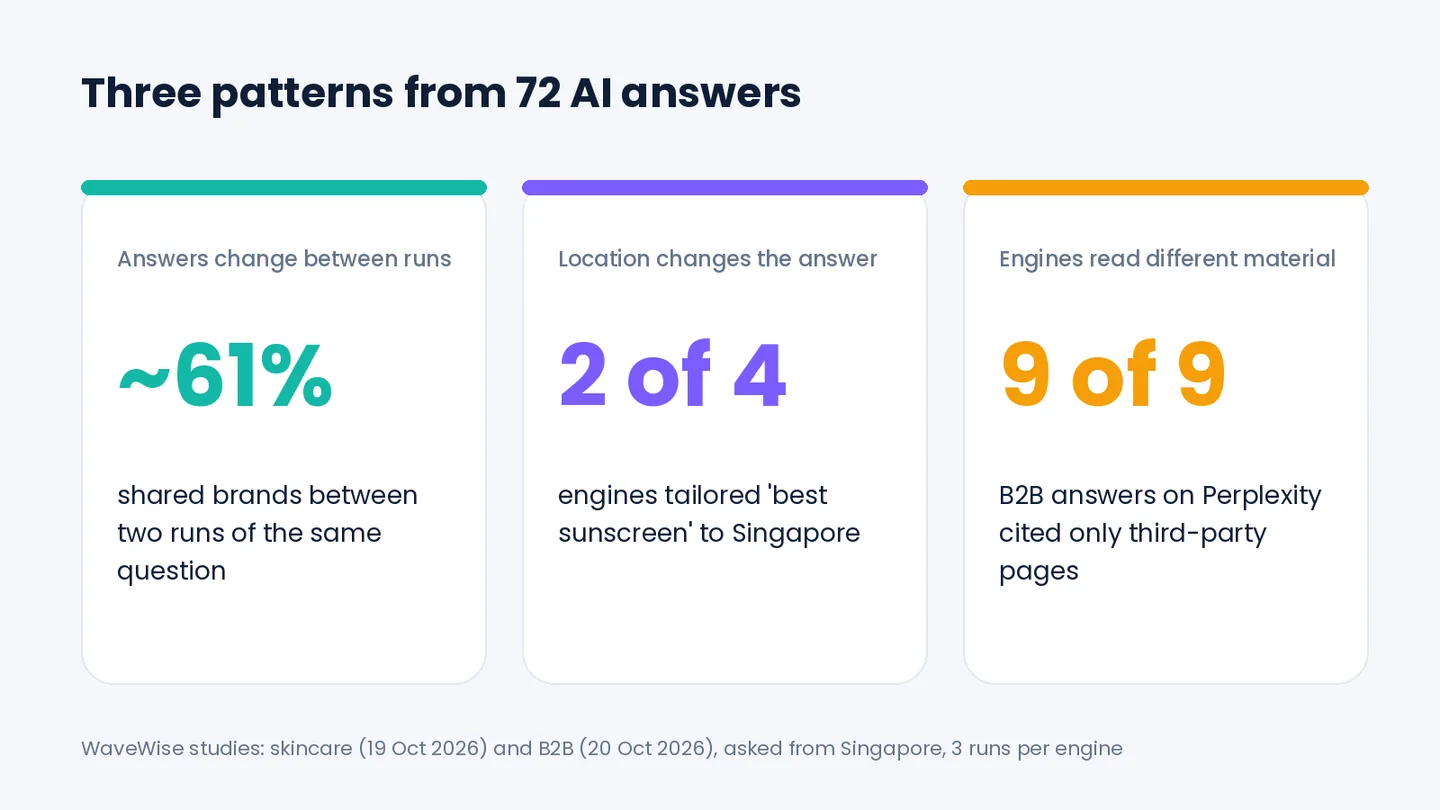
These patterns are why GEO needs its own checks, even inside SEO. A ranking report tells you where one page stands for one query. A GEO check has to cope with answers that vary every time, differ by market, and draw on material you may never see.
These are observations from two days, one location and six questions. They describe what we saw in those conditions.
GEO vs SEO vs AEO
| SEO | AEO | GEO | |
|---|---|---|---|
| Goal | Rank pages in search results | Get your text lifted as the direct answer | Get your brand named and cited inside AI-written answers |
| Where it shows up | Search result lists | Featured snippets, voice answers, AI answers | ChatGPT, Perplexity, Gemini, AI Overviews |
| What you measure | Rankings, clicks | Snippet and answer ownership | Mention rate across repeated answers, cited sources |
The terms overlap heavily, and the people writing about them disagree on where the lines fall. Our explainer on the difference between AEO and GEO compares how the top-ranking pages define them.
How to start with GEO
- Pick the buying questions that matter. Use the wording buyers use, from search data, sales calls or support tickets.
- Read the answers, several times per engine. Record who is named, in what order, and what the answer cites. Our guide on how to track brand mentions in AI search covers how many runs to use.
- Change one thing in the material the answers rely on. Your product page, a retailer listing, a review profile or a comparison page.
- Check that the change shipped, that the engine has seen it, and whether your mention rate moved.
The full method, with the skincare study behind it, is in our guide on how to improve brand visibility in AI search.
GEO for different businesses
For consumer brands, GEO is mostly about product facts: whether the details that make your product right for a specific buyer are stated clearly and consistently on your site and on the retailer and review pages AI answers draw on. Our guide to ChatGPT shopping for merchants covers the product-feed side.
For B2B companies, the question is a vendor shortlist, and the material is spread across vendor sites, review platforms and third-party roundups, with each engine leaning on a different mix. See GEO for B2B.
Where WaveWise fits
WaveWise starts from real buying questions, reads the answers buyers would see across engines, and records which brands were named and which sources the answers relied on. That becomes the baseline for one approved change and a re-test, the first step of the closed loop we use. For consumer brands, see WaveWise Merchant.
A measurement describes the answers during the window in which it was taken, and answers vary between runs, so it is a starting point for decisions. WaveWise does not guarantee that your brand will be recommended every time.
If you want a baseline on the questions your buyers ask, request a Pilot.
FAQ
What does GEO stand for in marketing?
Generative engine optimization: the work of getting a brand named and cited in answers written by AI tools such as ChatGPT, Perplexity, Gemini and Google’s AI Overviews.
What is GEO in SEO?
For Google, GEO is part of SEO. Google says its generative AI features are rooted in its core ranking and quality systems, and a page has to be indexed to appear in them (Google Search Central, read 2026-10-19). Other engines have not published equivalent guidance.
How is GEO measured?
By asking the same buying questions several times per engine and recording how often your brand appears, who appears alongside you, and which sources are cited. For Google, the Search Console Generative AI performance report adds first-party data (Google Search Central, read 2026-10-19).
Is GEO the same as AEO?
They overlap heavily and are often used interchangeably. AEO is older and tied to direct answers such as featured snippets; GEO comes from a 2023 research paper on generative engines. See the difference between AEO and GEO.
Can you pay to appear in AI answers?
Not inside the answer itself. OpenAI says ads in ChatGPT appear below the response, are labelled, and do not influence the answer (OpenAI Help Center, read 2026-10-19). What you can influence is the material answers are built from: your pages, retailer listings, and the reviews and articles that mention you.
Facts checked: 2026-10-21