
How to Track Brand Mentions in AI Search
On this page
To track brand mentions in AI search, pick the buying questions that matter and ask each one several times per engine, in fresh sessions, from your buyers’ market. Record which brands are named and which sources are cited. Track how often your brand appears across runs, not where it ranked in one answer, and re-run on a fixed schedule.
Most guides on this topic hand you a spreadsheet and a list of prompts, then stop. The harder question is how much to trust what you see. AI answers change every time you ask, so a mention you saw once may not be there for your buyer, and a ranking you recorded may never repeat. We looked at 36 answers we collected ourselves to put numbers on that, and built the method below around what they showed.
What counts as a brand mention in AI search
A brand can show up in an AI answer in four ways: it can be mentioned, recommended for the buyer’s need, cited as a source, or described (accurately or not). Our guide on how to improve brand visibility in AI search explains why each one needs a different fix. For tracking, you want to record all four, because a brand that is mentioned but never recommended has a different problem from one that is never mentioned at all. If the term GEO is new to you, start with what GEO is.
Why AI mentions are hard to track
The same question gets a different answer each time
AI engines generate each answer fresh. A study by SparkToro and Gumshoe.ai, in which volunteers ran identical prompts through ChatGPT, Claude and Google’s AI nearly 3,000 times, found that the same list of recommended brands came back less than 1% of the time (Search Engine Land, read 2026-10-19). Some brands still appeared in a large share of responses for the same intent. That is the pattern to track: how often a brand appears, not the exact list.
Where you ask from changes what you see
When we asked “best sunscreen” from Singapore on 19 October 2026, ChatGPT and Google’s AI Overview tailored their answers to Singapore, with references to the humid climate or local prices, and recommended Japanese and Korean brands. Perplexity and Gemini did not localize, and recommended mostly US brands. Same question, same hour, two almost separate sets of brands. If your buyers are in Singapore and you track from a US connection (or the reverse), you are measuring someone else’s answer.
Some engines don’t show their sources
In our study, ChatGPT showed no source links in any of its nine answers, while Perplexity and Google’s AI Overview showed sources every time. When an engine shows no sources, you can still record who was named, but you cannot see which pages shaped the answer, which is the part you would act on.
What 36 AI answers tell you about tracking
The data we used
These are the same 36 answers behind our study on how to improve brand visibility in AI search: three skincare buying questions (“best face moisturizer”, “best sunscreen” and “best moisturizer for dry sensitive skin”), each asked three times on ChatGPT, Perplexity, Gemini and Google’s AI Overview, from Singapore, on 19 October 2026, in a fresh session each time. That study reported which brands appeared. Here we look at something different: how much the answers changed between runs of the same question on the same engine, and what that means for anyone trying to track them.
How much the brand list changed between three runs
For each question on each engine, we compared every pair of runs and measured overlap: the brands named in both answers as a share of all brands named in either.
| Engine | Average overlap between runs | Brands per answer | Different brands seen across 3 runs (3 questions) |
|---|---|---|---|
| ChatGPT | 63% | 3 to 5 | 17 |
| Perplexity | 59% | 4 to 8 | 27 |
| Gemini | 60% | 5 to 8 | 27 |
| Google AI Overview | 63% | 4 to 7 | 21 |
Source: WaveWise study log, 36 answers, Singapore, 2026-10-19.
Across all four engines, two runs of the same question shared about 61% of their brands on average. Put the other way round: of all the brands named across a pair of runs, roughly two in five appeared in only one of the two, even though the runs were minutes apart.
How many brands you would miss by asking once
We then counted, for every engine and question, how many of the three runs each brand appeared in. That gives 92 brand-engine-question combinations.
| Appeared in | Brand-engine-question combinations | Share |
|---|---|---|
| All 3 runs | 42 | 46% |
| 2 of 3 runs | 24 | 26% |
| Only 1 run | 26 | 28% |
Source: WaveWise study log, 36 answers, Singapore, 2026-10-19.
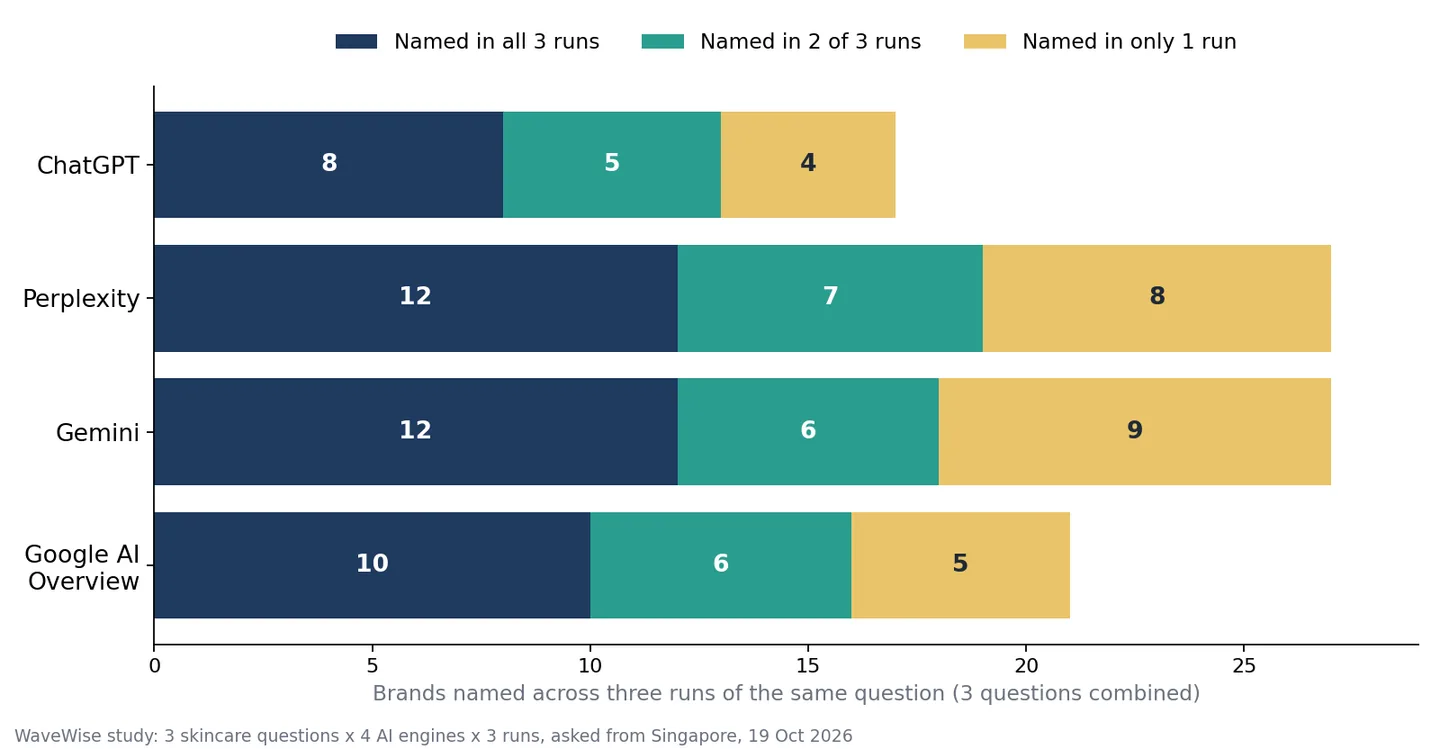
More than a quarter of the brands we saw appeared in only one of three runs. If you ask once, you might record one of those brands as “mentioned” or miss a brand that turns up two times in three. A single answer cannot tell you which situation you are in.
Whether a brand appears is steadier than where it ranks
Of the 42 combinations where a brand appeared in all three runs, it held the same position in the list all three times in only 14 (33%). By engine: ChatGPT 5 of 8, Google’s AI Overview 7 of 10, Perplexity 2 of 12 and Gemini 0 of 12.
Two caveats matter here. Perplexity and Gemini often grouped products by skin type rather than ranking them, so “position” for those engines means order of appearance, not a verdict on which is best. And Google’s sunscreen answers were unusually stable partly because all three relied on the same single source, a Singapore beauty blog. Even so, the direction is clear: a brand’s presence repeated far more reliably than its place in the list.
What this means for how many times you ask
Three runs per question per engine is the minimum we would use, and it is enough to separate brands that appear every time from brands that come and go. It is not enough to estimate a precise mention rate; if a number will drive a decision, ask more times. Our analysis has clear limits: one day, one location, three questions, three runs each. It describes what we observed, not a rule for every category.
How to track brand mentions in AI search, step by step
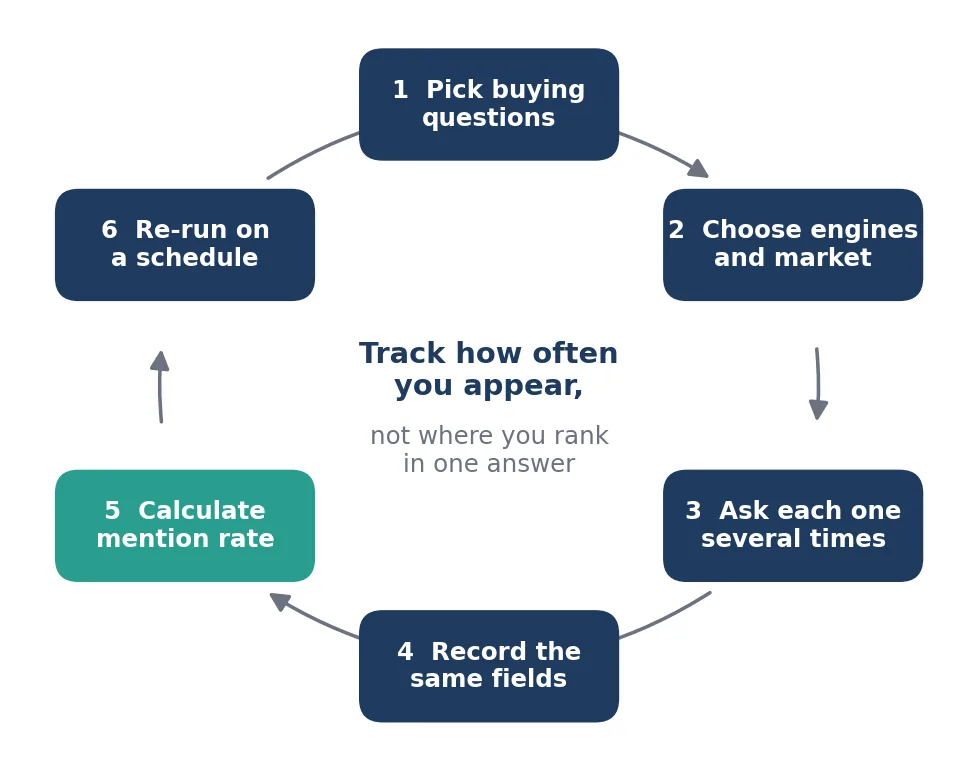
1. Pick the buying questions that matter
Start with questions a buyer asks right before choosing: “best [product] for [need]”, “[your brand] vs [competitor]”, “is [product type] worth it”. Search data shows how people phrase these; sales calls and customer-service logs show what they actually worry about. Keep the set small enough that you will read the answers, not just count them.
2. Choose engines and the market you ask from
Track the engines your buyers use, and ask from their market. Our sunscreen results show why: the market you ask from can change which brands appear at all. If you sell in several markets, track each one separately rather than averaging them.
3. Ask each question several times, in fresh sessions
Use a new chat every time, with memory and personalization turned off where the engine allows it (ChatGPT and Gemini both offer a temporary chat mode). Do not re-ask inside the same conversation: a follow-up answer is shaped by the previous one. We discarded and re-ran two answers for exactly this reason.
4. Record the same fields every time
| Field | Why it matters |
|---|---|
| Date, time and location | Answers change over time and by market |
| Engine, mode and login state | Model, temporary chat and account settings can change the answer |
| Brands named, in order | The raw data for mention rate and co-mentions |
| Products named | Shows whether the right product is attached to your brand |
| Cited sources and their type | The pages you can act on: retailer, review site, forum, your own site |
| How your brand is described | Catches wrong or outdated facts |
Keep what you observed separate from what you think it means. This is the same split our own process starts from: facts, inferences and unknowns.
5. Turn answers into a few numbers
Three numbers are usually enough. Mention rate: the share of answers that name your brand, per question and engine. Co-mentioned competitors: which brands appear alongside you, and how often. Cited sources: which pages the answers rely on, ranked by how often they appear. Skip “average position” unless the engine clearly ranks its picks; our data shows it is the least stable number you can collect.
6. Re-run on a schedule and compare like with like
Re-run the same questions, from the same market, with the same settings and the same number of runs. Compare mention rates, not single answers. If something changed on your side in between, such as a product page update or a new review, note the date so you can tell later whether the change was live before the re-run.
Manual tracking or a monitoring tool?
Manual tracking is enough to start: a handful of questions, three or more runs, a spreadsheet. It forces you to read the answers, which is where the reasons are.
Monitoring tools are better once the question set grows. They can run many prompts on a schedule, keep the history, and chart trends that would take hours to build by hand. Their limits are worth knowing. The prompts are a sample you choose, so the results are only as good as the questions. Location and account settings can differ from your buyers’, which our sunscreen results show can change the answer. And a dashboard tells you whether you appeared, not why; you still need to read the answers and their sources to decide what to change.
Using Google’s own data
For Google, there is first-party data: the Search Console Generative AI performance report shows how your content performs in Google’s generative AI features (Google Search Central, read 2026-10-19). It covers Google only, so you still need your own runs for ChatGPT, Perplexity and Gemini.
From tracking to action
A mention rate tells you where you stand, not what to do. The next step is to read the answers where you were missing, note which sources they relied on, and change one thing. Then check, separately, that the change went live and that the engine has read it, as part of three levels of verification. Our guide on how to improve brand visibility in AI search covers this in six steps.
For B2B companies the same tracking applies to shortlist questions, where answers often lean on comparison pages and review sites. See how buying teams compare vendors. Our guide to GEO for B2B shows which sources each engine cited for shortlist questions.
Where WaveWise fits
WaveWise Merchant starts where tracking usually stops. It begins from one real buying question, often the one behind why isn’t ChatGPT recommending us?, reads the answers across engines, and records who was named and which sources the answers relied on. That record becomes the baseline for a single, approved change and a re-test, and the result is kept in Decision Memory so the next decision starts from it.
A measurement describes the answers during the window in which it was taken; because answers vary between runs, it is a starting point for decisions, not a permanent score. WaveWise does not guarantee that your brand will be recommended.
If you want a baseline on the questions your buyers ask, request a Pilot.
FAQ
Can I track brand mentions in ChatGPT for free?
Yes, manually. Ask your buying questions in a new temporary chat each time, record the brands named and any sources, and repeat several times. In our runs, ChatGPT’s temporary chat noted that it can still use memory and custom instructions, so check those settings before you start.
How many times should I ask the same question?
At least three times per engine. In our 36 answers, more than a quarter of the brands appeared in only one of three runs, so a single answer can mislead you in either direction. Ask more often if a decision depends on a precise rate.
How often should I re-check?
On a fixed schedule that you can keep, and always after a change you want to measure. Keep the questions, market, settings and number of runs the same each time so the results are comparable.
Do AI visibility tools see the same answers my buyers see?
Not necessarily. Answers vary between runs and can change with location and account settings. A tool’s results reflect its own prompts, location and settings, so check that these match your buyers’ situation.
Is there a Search Console report for AI features?
Yes. Google’s Search Console has a Generative AI performance report for its generative AI features (Google Search Central, read 2026-10-19). It does not cover other AI engines.
Facts checked: 2026-10-20 · Study data collected: 2026-10-19, Singapore