
How to Improve Brand Visibility in AI Search Engines
On this page
To improve brand visibility in AI search engines, start from the questions real buyers ask, read the full answers, and note which brands are named, why, and which sources the answer relied on. Then fix that source material one change at a time, and check two things separately: that the change went live, and that the AI has read it.
Most advice on this topic stops at “create great content” or “track your mentions.” Both are true and neither tells you what to do on Monday morning. This guide shows how to improve brand visibility in AI search engines with a method you can run and check, and the results of a small study we ran on skincare questions so you can see what AI answers actually look like before you start changing things.
What brand visibility in AI search actually means
“Visibility” gets used as one number, but in an AI answer your brand can show up in four different ways, and each one has a different fix.
Mentioned, recommended, cited, described correctly: four different things
| What happens in the answer | What it means | What usually drives it |
|---|---|---|
| Mentioned | Your brand name appears somewhere in the answer | The brand is commonly discussed in the sources the AI retrieves |
| Recommended | Your brand or product is put forward as a choice for this buyer | The sources say your product fits the buyer’s specific need (skin type, budget, use case) |
| Cited | Your page is linked as a source | Your page is retrievable and says something specific the answer needed |
| Described correctly | What the AI says about you is accurate and current | Your facts are consistent across your site, retailers and reviews |
A brand can be mentioned and never recommended, or cited for a definition while a competitor gets the recommendation. Knowing which of the four you are missing tells you where to look.
Why a single “visibility score” hides the reason you were left out
A score tells you how often you appeared. It does not tell you why you didn’t. And the “how often” part is less stable than most dashboards suggest: a study by SparkToro and Gumshoe.ai, in which volunteers ran identical prompts through ChatGPT, Claude and Google’s AI nearly 3,000 times, found that the same list of recommended brands came back less than 1% of the time, while some brands still appeared in a large share of responses for the same intent (Search Engine Land, read 2026-10-19). The useful signal is how often a brand appears across many runs, not where it ranked in one answer.
So treat any single answer as one draw, and treat the reason behind the answer as the thing you can act on.
How AI assistants decide which brands to name
Where the answer’s material comes from
AI search engines that show sources generally build answers from web pages they retrieve at the moment you ask. Google is explicit about this for its own AI features: AI Overviews and AI Mode are rooted in its core Search ranking and quality systems, use retrieval-augmented generation to pull pages from the Search index, and use “query fan-out” (running several related searches in parallel) to gather more material (Google Search Central, read 2026-10-19).
Two practical consequences follow. First, if a page can’t be crawled and indexed, it can’t be used. Google states that a page must be indexed and eligible to show with a snippet to appear in its generative AI features. Second, fan-out means your product can be pulled in by a related question you never targeted: a question about “best moisturizer for dry skin” may trigger searches about specific ingredients or skin conditions.
Google’s guide also says its AI features can reflect what is said about products across blogs, videos and forums. For brands, that means much of the material that decides a recommendation is not on your own site. It is also the first question WaveWise Merchant is built to answer: why isn’t ChatGPT recommending us?
Why specific, consistent product facts get repeated
This part is our inference from how retrieval works, not a published rule: when an answer needs to say why a product suits a buyer, it can only use reasons that appear in the material it retrieved. A product page that says “lightweight, suits all skin types” gives the answer nothing to work with. A page that states the SPF, the filter type, the finish, the skin types it was tested on, and how it differs from the brand’s other products gives the answer specific reasons. Those reasons are also easier to repeat consistently across retailers and reviews.
The study below can’t prove this inference, but it does show which sources the answers relied on.
What we found: 3 skincare buying questions across 4 AI engines
How we ran it
We took three real search queries about face moisturizers and sunscreens (two broad, high-volume ones and one more specific) and asked each one, word for word, to four AI engines: ChatGPT, Perplexity, Gemini and Google’s AI Overviews. We asked from Singapore, without a VPN, on 19 October 2026 between about 17:40 and 18:20 local time. Each question was asked three times per engine in a fresh session, giving 36 answers. For every answer we recorded the brands named and their order, the products named, every source shown, and the type of each source.
Setup per engine: ChatGPT in Temporary Chat (Instant model); Perplexity in Search mode on a free account; Gemini in Temporary chat (Flash model); Google Search in English, counting only brands inside the AI Overview itself, not the shopping carousel or ads around it.
| # | Question asked (verbatim US search query) | US monthly searches |
|---|---|---|
| 1 | best face moisturizer | 14,800 |
| 2 | best moisturizer for dry sensitive skin | 1,000 |
| 3 | best sunscreen | 22,200 |
Search volumes: Semrush, read 2026-10-19.
Limits of this study. Three questions, one location (Singapore), one collection window of about 35 minutes, and three runs per question per engine. Some answers were clearly localized. ChatGPT and Google’s AI Overviews referred to Singapore’s climate, local retailers or prices in Singapore dollars, so a buyer elsewhere would likely see different brands. Given how much AI answers vary between runs, these results describe what a buyer in Singapore would likely have seen during our collection window; they are not a ranking of skincare brands and should not be read as one.
Which brands appeared, and how consistently
La Roche-Posay was the only brand named in every one of the 36 answers. CeraVe appeared in all 12 answers to the dry, sensitive skin question and in 9 of 12 for face moisturizer. Below the top two or three names, answers varied a lot: 46 different brands were named in total, and 13 of them appeared in only one answer.
| Brand | best face moisturizer (of 12) | best moisturizer for dry sensitive skin (of 12) | best sunscreen (of 12) | All answers (of 36) |
|---|---|---|---|---|
| La Roche-Posay | 12 | 12 | 12 | 36 |
| CeraVe | 9 | 12 | 0 | 21 |
| Vanicream | 4 | 8 | 0 | 12 |
| Neutrogena | 8 | 0 | 3 | 11 |
| Kiehl’s | 6 | 2 | 0 | 8 |
| Aestura | 2 | 5 | 0 | 7 |
| Beauty of Joseon | 0 | 0 | 7 | 7 |
| Anessa | 0 | 0 | 6 | 6 |
| EltaMD | 0 | 0 | 6 | 6 |
| Supergoop! | 0 | 0 | 6 | 6 |
| Avène | 0 | 5 | 0 | 5 |
| Bioré | 0 | 0 | 5 | 5 |
Number of answers that named the brand at least once. Brands named in at least 5 of 36 answers. Each question was asked 12 times: 4 engines × 3 runs. Source: WaveWise study log, Singapore, 2026-10-19.
Repeat runs rarely matched. Across the 36 pairs of repeat runs (same engine, same question), the brand list came back in exactly the same order once. No engine gave the same list in all three runs of any question. That is consistent with the SparkToro study above, at a much smaller scale.
The engines also disagreed with each other, most clearly on sunscreen. ChatGPT named Anessa, Beauty of Joseon and La Roche-Posay in all three runs, and Google’s AI Overview named Bioré, La Roche-Posay, Anessa and Beauty of Joseon in all three, all brands widely sold in Singapore. Perplexity named EltaMD, Supergoop!, Banana Boat, Blue Lizard and La Roche-Posay in all three runs, and Gemini named EltaMD, Supergoop! and La Roche-Posay in all three. Those two shortlists look closer to US buying guides.
| Engine | Brands named per answer (average) | Different brands across its 9 answers | Brands named in all 3 runs (summed over 3 questions) | Answers that showed sources (of 9) |
|---|---|---|---|---|
| ChatGPT | 4.2 | 11 | 8 | 0 |
| Perplexity | 6.4 | 22 | 12 | 9 |
| Gemini | 6.3 | 22 | 12 | 3 |
| Google AI Overview | 5.2 | 18 | 10 | 9 |
Source: WaveWise study log, Singapore, 2026-10-19.
Which sources the answers relied on
21 of the 36 answers showed their sources. ChatGPT, used in Temporary Chat with its Instant model, showed no source links in any of its 9 answers, so we can’t say what it relied on. Gemini showed sources in 3 of 9; in 2 more we did not capture them. Perplexity and Google’s AI Overviews showed sources in all 9 answers each.
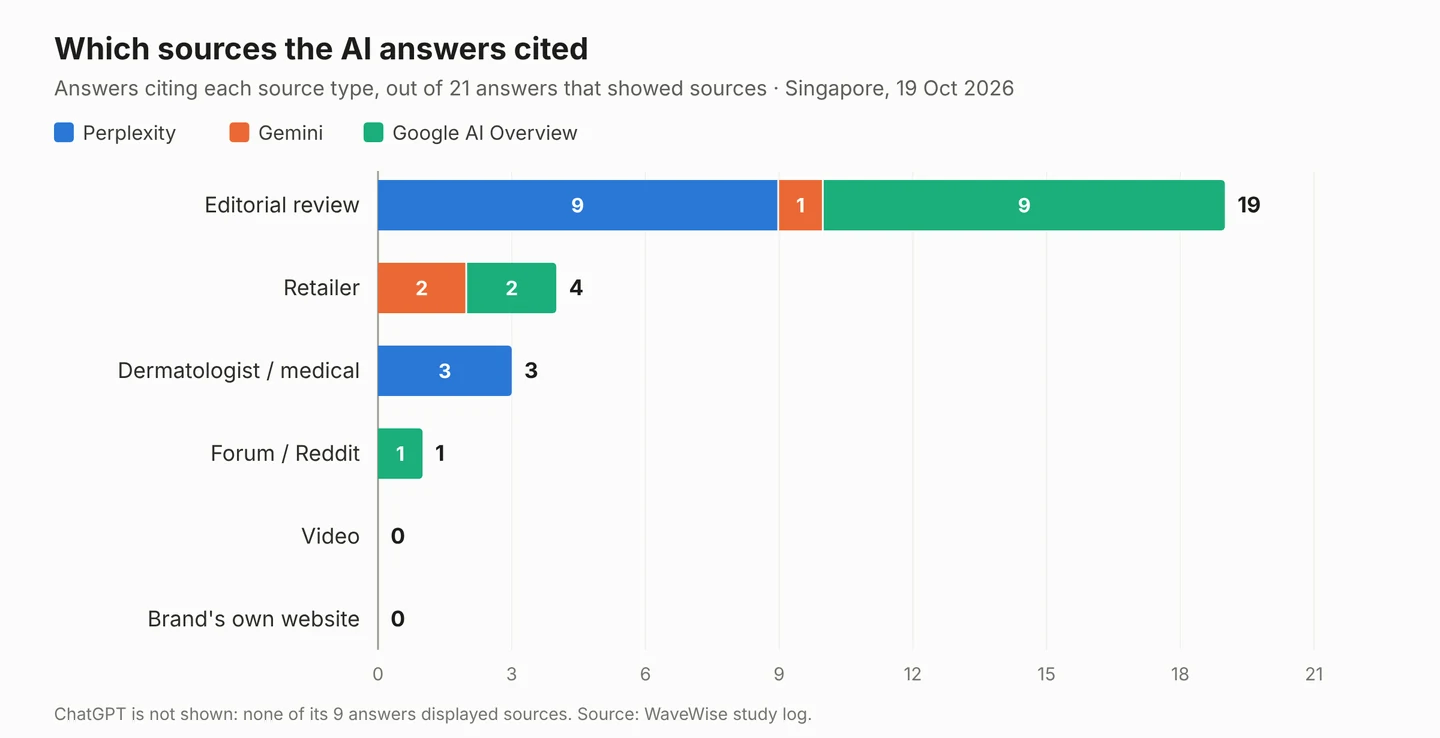
No answer cited a brand’s own website. Editorial reviews (magazine roundups, news sites’ buying guides and beauty blogs) appeared in 19 of the 21 answers that showed sources.
| Source type | Perplexity (of 9) | Gemini (of 3) | Google AI Overview (of 9) | Total (of 21) |
|---|---|---|---|---|
| Editorial review (magazine, blog, news) | 9 | 1 | 9 | 19 |
| Retailer | 0 | 2 | 2 | 4 |
| Dermatologist / medical site | 3 | 0 | 0 | 3 |
| Forum / Reddit | 0 | 0 | 1 | 1 |
| Video | 0 | 0 | 0 | 0 |
| Brand’s own website | 0 | 0 | 0 | 0 |
Number of answers citing at least one source of that type. ChatGPT is not shown because none of its answers displayed sources. Source: WaveWise study log, Singapore, 2026-10-19.
| Most-cited source (as labelled in the answer) | Answers citing it (of 21) | Engines |
|---|---|---|
| Byrdie | 10 | Perplexity; Google AI Overview |
| Allure | 6 | Perplexity; Google AI Overview |
| Fortune | 6 | Perplexity |
| The New York Times | 6 | Perplexity |
| Everyday Health | 5 | Perplexity |
| Sephora Singapore | 4 | Gemini; Google AI Overview |
| CNN | 3 | Perplexity |
| Cleveland Clinic | 3 | Perplexity |
| Health.com | 3 | Perplexity |
| NBC News | 3 | Perplexity |
| koreanskincare.nl | 3 | Google AI Overview |
| sgbeautyblog.com | 3 | Google AI Overview |
Sources cited in at least 3 answers. Source: WaveWise study log, Singapore, 2026-10-19.
What a skincare brand could act on from this
1. Most of what decided these answers was not on brand websites. Observation: None of the 21 answers that showed sources cited a brand’s own site; 19 cited editorial reviews and 4 cited retailers. Inference: For a skincare brand, step 3 of the method below will usually mean making sure review roundups and retailer listings carry accurate, specific information about the product, rather than rewriting the homepage.
2. One page can carry an answer. Observation: Google’s AI Overview for “best sunscreen” cited a single Singapore beauty blog in all three runs and opened with the same four brands each time. Inference: When an answer rests on one source, that page matters more than broad coverage. Find it before doing anything else.
3. “The market” is different on each engine. Observation: The same sunscreen question produced largely different shortlists on ChatGPT and Google than on Perplexity and Gemini. Inference: Check the engines your buyers actually use, from where they actually are. A result on one engine says little about another.
4. Being named once means little; being named every time means a lot. Observation: The leaders were stable (La Roche-Posay appeared in 36 of 36 answers), while 13 of 46 brands appeared only once. Inference: A brand at the edge of the list should measure how often it appears over repeated runs before deciding whether a change worked.
A six-step method to improve your visibility and check it worked
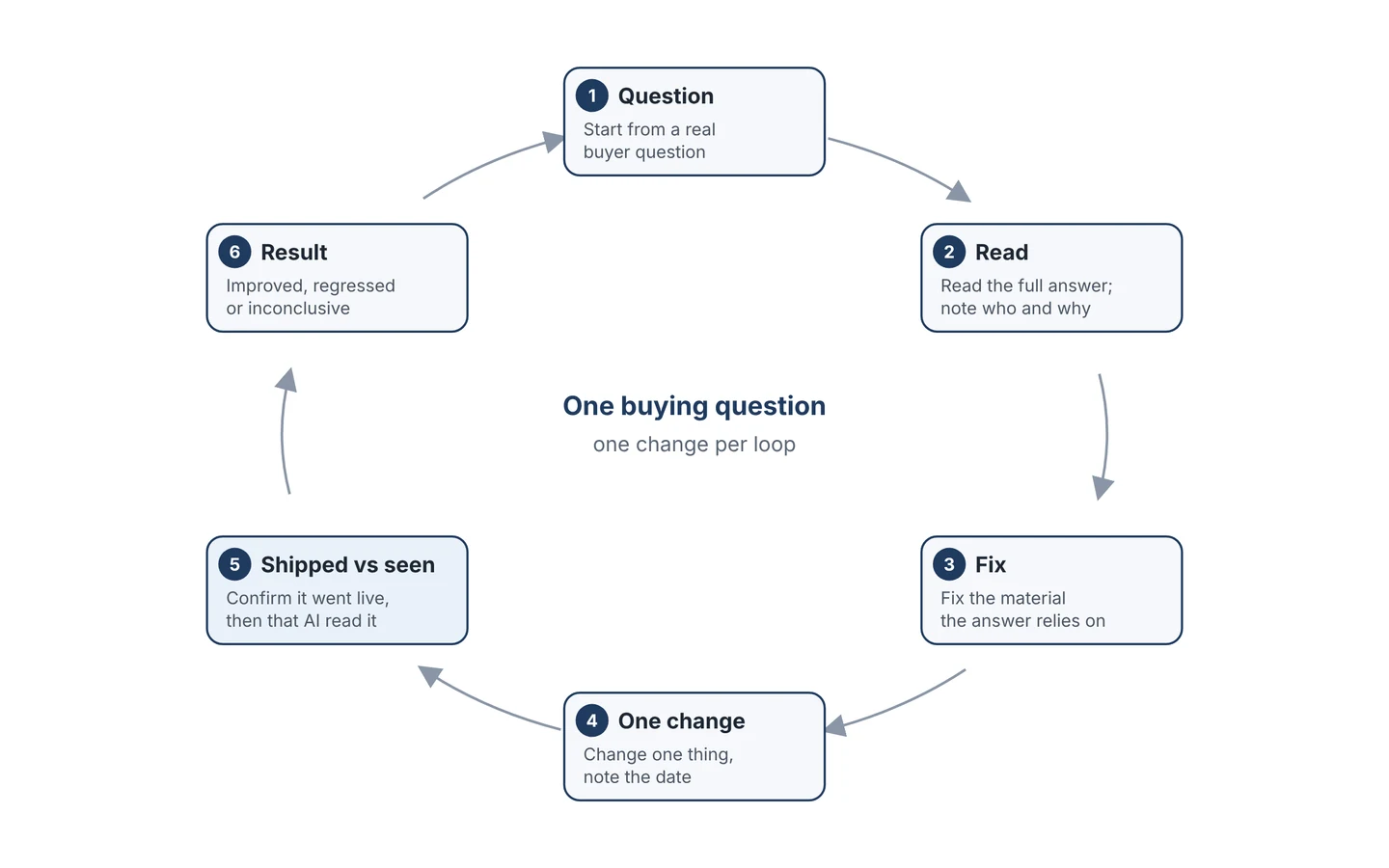
1. Start from real buyer questions, not keywords you want to rank for
Pick a small set of questions a real buyer would ask before choosing a product like yours, the kind that end in a decision. Search data is a good source because it reflects how people actually phrase things; customer-service logs and sales calls are another. Five well-chosen questions you understand beat a hundred you only count.
2. Read the full answer and write down the reason you were left out
Read each answer end to end, more than once, across the engines your buyers use. For each, write down who was named, what reason was given for each recommendation, and which sources were cited. Then write one sentence: “We were not recommended because the answer relied on X, and X does not say Y about us.” That sentence is your diagnosis. Keep what you observed separate from what you are guessing. It is the same split our own process starts from: facts, inferences and unknowns.
3. Fix the material the answer points to
If the answer leaned on a retailer listing, fix the retailer listing. If it leaned on a review roundup that doesn’t include you, that is a different problem from your own product page being vague. Google notes that its AI responses can include product listings and that Merchant Center feeds and Business Profiles help products and businesses appear in AI responses and other Search results (Google Search Central, read 2026-10-19). For a consumer brand, product data quality affects visibility as well as ads.
What not to spend effort on, at least for Google: Google says you do not need llms.txt files, special AI markup, content “chunking,” AI-specific rewrites, or manufactured mentions to appear in its generative AI features (Google Search Central, read 2026-10-19).
4. Change one thing at a time
If you rewrite the product page, update three retailer listings and pitch two reviewers in the same week, you will not know which one mattered, or whether any did. Make one controlled change, note the date, and keep everything else as it was. Give each change an approver and a way to roll it back, so a change that hurts can be undone.
5. Confirm it shipped, then confirm it was seen
These are two different checks. “Shipped” means the change is live on the page. “Seen” means the AI has evidence of the new version: the page is indexed in its current form, or the answer now quotes or cites the updated content. A change can be live for days before any engine reads it. Treating “shipped” as “done” is the most common way teams conclude a change “didn’t work” when it was never read. We treat them as two of three levels of verification, alongside whether results moved.
6. Call the result: improved, regressed, or inconclusive
After the change has been seen, re-ask the same questions, the same way, the same number of times as your baseline. Compare how often you appeared, not where you ranked in a single answer. Then call it one of three things. Inconclusive is a legitimate result. It usually means the change was too small, the sample too small, or the answer depends on something you haven’t touched yet. Whichever you call, record it with the context and evidence behind it, so the next decision starts from what you learned. That is the idea behind Decision Memory.
Applying the same method to B2B shortlists
When B2B buyers ask AI to find and compare vendors, the method is the same: start from the shortlist questions buyers ask (“best [category] software for [company type]”), read who gets named and why, and fix the material those answers rely on: comparison pages, review sites, analyst mentions, your own product documentation. Our working inference is that B2B answers lean more heavily on third-party comparisons, which would mean step 3 usually happens off your site. Check this against the sources your own answers cite. Seeing the comparison from the buyer’s side helps too: how buying teams compare vendors.
Mistakes that waste effort
- Chasing one score. A single visibility number moves with the randomness of the answers. Track appearance rates over repeated runs instead.
- Changing many things at once. You lose the ability to say what worked.
- Reading one screenshot as a trend. One answer is one draw. Three runs is a minimum; more is better.
- Only editing your own site. If the answers rely on retailers, reviewers and forums, your homepage copy is not the bottleneck.
- Buying “AI hacks.” Google specifically lists tactics it ignores for its own AI features. Other engines haven’t published equivalent guidance, but there is no evidence that shortcuts outperform clear, specific, consistent product information.
How to track progress over time
Knowing how to improve brand visibility in AI search engines is only useful if you can tell whether it worked. For Google, the Search Console Generative AI performance report shows how your content performs in its generative AI features (Google Search Central, read 2026-10-19). For other engines there is no official equivalent, so you rerun your question set on a fixed schedule and compare appearance rates.
Where WaveWise fits
WaveWise Merchant applies the method in this guide to the buying questions that matter to a consumer brand. It tracks how your brand appears, is cited and is described in AI answers to the questions you agree on, and works through them as a closed loop:
See where you stand. For each question, WaveWise reads the answers across AI engines and records which brands are named, how yours is described, and which sources the answers relied on. Findings are kept apart as facts, inferences and unknowns.
Find the gap you control. It tests competing explanations for why you were left out or described wrongly, rates the evidence for each, and points to the material you can fix: a product page, a retailer listing, the detail a review roundup is missing.
Decide one change. Each recommendation arrives as a Decision Card with the evidence, one proposed change, stop conditions and an approver. Nothing runs until you approve it. Your team or WaveWise then makes the change, and it can be rolled back.
Verify, then keep the lesson. WaveWise checks three things separately: that the change shipped, that AI engines picked it up, and whether your presence or description moved. The result is called improved, regressed or inconclusive. The conclusion, with its evidence, goes into Decision Memory, so the next question starts from what you have already learned.
Applied to the skincare study above, the loop would start from the sources table. If the answers to your buying question rely on two review roundups and a retailer page, those are the first places to check what is said about your product.
If you want to see where your brand stands on the questions your buyers ask, request a Pilot.
FAQ
Can you pay to appear in ChatGPT or Perplexity answers?
Not into the answer itself. ChatGPT began testing ads in the US on 9 February 2026 for logged-in adults on its Free and Go plans; OpenAI says ads appear below the response, are clearly labelled, and do not influence ChatGPT’s answers (OpenAI Help Center, read 2026-10-19). Perplexity, which had shown sponsored placements beneath answers since November 2024, is winding its ad program down by the end of 2026 (Campaign, citing the Financial Times, 20 February 2026). So paying can put a labelled ad next to an answer, not your brand inside it. What you can influence is the material answers are built from: your product pages, retailer listings, and the reviews and discussions that mention you.
How long before a change shows up in AI answers?
There is no fixed timeline. The change has to be crawled and indexed first, and then it has to be retrieved for the questions you care about. That is why the method separates “shipped” from “seen”: check that the updated page has been read before judging the result.
Does traditional SEO still matter for AI search?
Yes, at least for Google. Google says its generative AI features are rooted in its core Search ranking and quality systems, so SEO best practices remain relevant (Google Search Central, read 2026-10-19). For Google, then, much of how to improve brand visibility in AI search engines is the same work as good SEO.
Is GEO the same as AEO?
Both describe work aimed at visibility in AI-generated answers; the terms are often used interchangeably. Google’s position is that, for Google Search, this work is still SEO.
How can I tell whether AI mentions my brand?
Ask the questions your buyers ask, in fresh sessions, several times per engine, and record the answers. For Google, use the Generative AI performance report in Search Console.
Facts checked: 2026-10-19 · Study data collected: 2026-10-19, Singapore