
AEO vs GEO: What's the Difference, and Does It Matter?
On this page
AEO (answer engine optimization) means making your content easy for answer features, such as featured snippets, voice assistants and AI answers, to lift and quote. GEO (generative engine optimization) means getting your brand included and cited in answers that AI writes, in ChatGPT, Perplexity or Google’s AI Overviews. The two overlap heavily, and Google treats this work as SEO.
If you have read three articles on AEO vs GEO and come away with three different answers, the problem is the articles. We read the pages that currently rank on Google for “aeo vs geo” and found they disagree on the basics, including whether the two terms describe different things at all.
AEO vs GEO at a glance
| AEO | GEO | |
|---|---|---|
| Full name | Answer engine optimization | Generative engine optimization |
| Where the term comes from | Search marketing practice, tied to featured snippets, People Also Ask and voice answers | A research paper first published in November 2023 |
| Where it shows up | Answer boxes, snippets, voice assistants, AI answers | AI-written answers in ChatGPT, Perplexity, Gemini, AI Overviews |
| What success looks like | Your text is lifted as the answer | Your brand or page is named, recommended or cited inside a generated answer |
| How you measure it | Snippet and answer-box ownership; citations in AI features | How often you appear across repeated AI answers, and which sources are cited |
| Typical work | Clear question-and-answer structure, concise definitions, structured data | Specific, consistent facts across your site and the third-party pages AI relies on |
What AEO means
AEO is the older of the two terms. It grew out of search marketing work on direct answers: featured snippets, People Also Ask and voice assistants. One of the top-ranking pages, from Terakeet, notes that AEO used to refer to optimizing rich-snippet features and was close to a synonym for rich-snippet optimization (Terakeet, read 2026-10-20). The core idea has not changed: write so that a machine can lift a clean, correct answer out of your page.
What GEO means
The term comes from the paper “GEO: Generative Engine Optimization” by Pranjal Aggarwal, Vishvak Murahari and colleagues at Princeton University and IIT Delhi, first published on arXiv on 16 November 2023 and presented at ACM SIGKDD 2024 (arXiv 2311.09735, read 2026-10-20). The paper frames “generative engines” as systems that gather sources and summarize them into an answer, and treats GEO as the work of improving a source’s visibility inside those answers. Where AEO asks “can my text be lifted?”, GEO asks “will the engine use my page, or mention my brand, when it writes the answer?” Our guide on what GEO is goes further, with examples from 72 real AI answers.
Where SEO fits: SEO vs GEO vs AEO
Google’s guide to optimizing for generative AI features on Google Search says this work is still SEO: its AI Overviews and AI Mode are rooted in its core ranking and quality systems, and a page has to be indexed and eligible for a snippet to appear in them (Google Search Central, read 2026-10-19). The same guide lists tactics you do not need for Google, including llms.txt files and special AI markup.
So for Google, AEO and GEO sit inside SEO. Other engines have not published equivalent guidance, which is one reason the terms keep multiplying: people are naming the parts of the work that SEO tools and habits did not cover, such as reading a whole AI answer, or tracking which third-party pages it relied on.
What the top-ranking pages say
How we did it
We took the Google US top 10 for “aeo vs geo” from Semrush on 20 October 2026 and read each page. For every page we recorded how it defines AEO and GEO, whether it treats them as the same, overlapping or different, whether it mentions Google’s published guidance, and whether it cites where the term GEO comes from. One result, a Reddit thread at number 1, could not be read by our tools, so the analysis covers nine pages.
Where they disagree
| Rank | Page | Published | AEO and GEO are… | Mentions Google’s guidance | Cites the GEO paper |
|---|---|---|---|---|---|
| 2 | Digiday | Oct 2025 | The same trend under different acronyms | No | No |
| 3 | Profound | Jun 2025 | Essentially the same strategy; prefers “AEO” | No | No |
| 4 | First Line Software | Not shown | Overlapping work | No | Yes |
| 5 | Nowspeed | Apr 2025 | Closely related but not identical | No | No |
| 6 | Graphite | Oct 2025 | Competing names for one practice; prefers “AEO” | No | No |
| 7 | Hibu | Jan 2026 | Separate terms, with AIO as the umbrella | No | No |
| 8 | Adobe | Not shown | Different mechanisms needing distinct approaches | No | No |
| 9 | Digital Marketing Institute | Not shown | Separate disciplines | No | No |
| 10 | Terakeet | Jun 2025 | Related but distinct; AIO closest to GEO | No | No |
Source: WaveWise reading of each page, 2026-10-20. Ranks from Semrush, Google US, 2026-10-20.
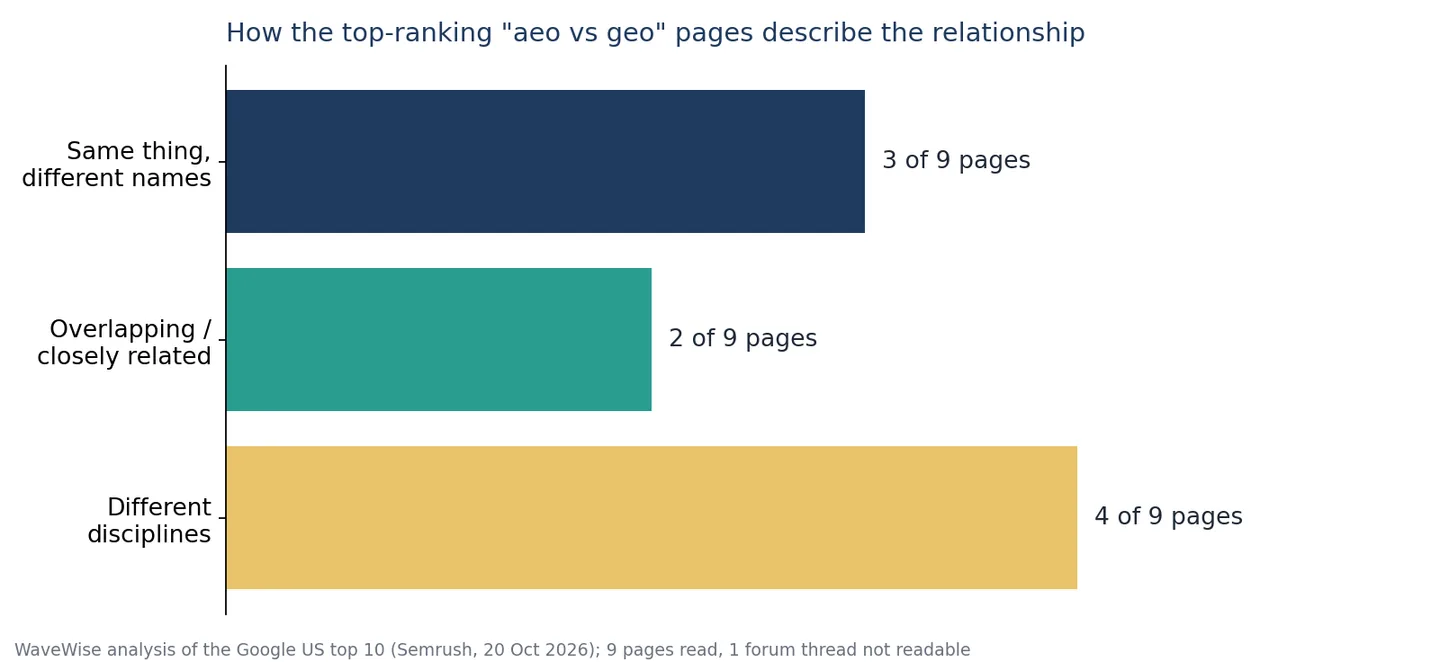
The pages split almost evenly: three say AEO and GEO are the same thing, two say they overlap, and four treat them as different disciplines. None of the nine refers to Google’s own guidance, even though Google has published a direct answer to the question “is this still SEO?”. Only one cites the research paper the term GEO comes from.
Some of the disagreement is about naming. Graphite surveyed practitioners in October 2025 and found “AEO” preferred over “AI SEO” and “GEO” (Graphite, read 2026-10-20), which is a question of vocabulary more than method.
What this tells you
If the people writing about this cannot agree where the boundary falls, building two separate programs around it is risky. A more useful split is what you are trying to change: whether your text gets lifted as the answer, or whether your brand gets chosen as a recommendation.
Do you need separate AEO and GEO strategies?
For most teams, no. The work is largely the same: clear answers near the top of the page, real tables rather than images of tables, specific product or service facts, and consistency between your site and the third-party pages that answers rely on. Where the two lenses differ is in what you check afterwards. An AEO check asks whether your answer was lifted. A GEO check asks whether your brand was named across repeated answers, and which sources the answers leaned on.
Our guide on how to improve brand visibility in AI search sets out one method that covers both.
How to measure AEO and GEO
| KPI | Where to get it | |
|---|---|---|
| AEO | Featured snippet and People Also Ask ownership for your target questions | Your rank tracker, or a manual check |
| AEO | Appearance in Google’s AI features | Search Console Generative AI performance report (Google Search Central, read 2026-10-19) |
| GEO | Mention rate: share of repeated AI answers that name your brand | Your own runs, several per question and engine |
| GEO | Co-mentioned competitors | The same runs |
| GEO | Cited sources | Engines that show sources, such as Perplexity and AI Overviews |
The GEO numbers need repeated runs because AI answers change each time you ask. Our guide on how to track brand mentions in AI search shows how many runs to use and what to record.
Content that works for both
- A direct answer under the main heading. Forty to sixty words that answer the question on their own. This is what answer features lift, and what AI answers paraphrase.
- A real comparison table. Rows and columns in HTML, not a screenshot, so both search engines and AI systems can read the cells.
- Dated original data. A number with a method and a date gives an answer something specific to cite.
- FAQ sections that match how people ask. Each question as its own heading, answered in a few sentences.
- The same facts everywhere. Your product page, retailer listings and review profiles should agree on the details an answer would use, such as size, ingredients, price band or who it is for.
Where WaveWise fits
WaveWise starts from real buying questions, reads the answers buyers would see, and records which brands were named and which sources the answers relied on. That is the first step of the closed loop we use: a baseline, one approved change, and a re-test. For consumer brands, see WaveWise Merchant; for B2B companies, WaveWise Business.
A measurement describes the answers during the window in which it was taken, and WaveWise does not guarantee that your brand will be recommended. If you want a baseline on the questions your buyers ask, request a Pilot.
FAQ
Are AEO and GEO the same thing?
They overlap heavily, and the top-ranking pages disagree. In our reading of nine of them, three said they are the same, two said they overlap and four treated them as different. In practice, most of the work is shared; the difference is mainly in what you measure afterwards.
What does AEO stand for?
Answer engine optimization: making content easy for answer features, such as featured snippets, voice assistants and AI answers, to lift and quote.
Is AIO the same as GEO?
Not always. AIO is used in two ways: for “AI optimization” as a broad umbrella term, as Hibu uses it, and, more loosely, as shorthand for Google’s AI Overviews. Terakeet describes AI optimization as the closest of the terms to GEO. Check which meaning a source intends.
Does GEO replace SEO?
No. Google says optimizing for its generative AI features is still SEO, and a page has to be indexed to appear in them (Google Search Central, read 2026-10-19). For other engines, a crawlable, well-structured site is still the starting point.
Which should I start with?
Start with the questions your buyers ask and read the answers they get. If your text is not being lifted, work on structure and direct answers. If your brand is not being named, look at the sources the answers rely on. The label matters less than the gap you find.
Facts checked: 2026-10-20